“Juden, Baptized and Unbaptized”:
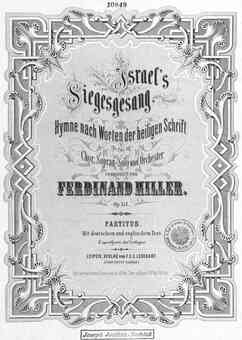
Jewishness and Ferdinand Hiller’s 'Israel’s Siegesgesang'
Thursday, April 4, 2024
|
|
About the Program:
German composer Ferdinand Hiller (1811-85) lived and worked throughout a period of tumultuous change, marked by unprecedented movement (both geographic and socio-economic), active assimilation, and formalized emancipation for the Jews of German-speaking Europe. A piano prodigy and student of Hummel, he was a direct contemporary of Felix Mendelssohn, with whom he was personally and professionally close. Hiller, who was baptized at the age of 29, had a complex engagement with Jewishness and Judaism, which has thus been variously essentialized as a pervasive part of his identity to mere circumstance of birth, ignored and forgotten. Of several compositions explicitly engaging with Jewish texts, his 1840 oratorio, Die Zerstörung Jerusalems, was a widely acclaimed success throughout Germany and beyond, whereas Hiller’s eight-movement choral work, Israel’s Siegesgesang, op. 151 (1871) had a more modest initial reception. This presentation shows how Hiller, by this point a well-established teacher and musical authority on the classical and early romantic traditions, used Psalm and other texts from the Hebrew Bible in Israel’s Siegesgesang to reflect current political sentiment following the Battle of Sedan, which ended the Franco-Prussian war of 1870. Amanda Ruppenthal-Stein will trace this work’s appearance from German-speaking Europe to English audiences in London, Cincinnati, Boston, and San Francisco, and finally in the 1897 edition of the Union Hymnal, showing how not only did Hiller clearly recognize his Jewish heritage and engage with it in varied ways throughout his life, but also the recognition of him as member of the broader Jewish community, regardless of his baptismal status.
This event is co-sponsored by The YIVO Institute for Jewish Research.
About the Speaker
Musicologist Amanda Ruppenthal Stein, Ph.D. is a lecturer in music at Carroll University in Waukesha, Wisconsin. She is a 2020 graduate of the Bienen School of Music at Northwestern University, where she was also the Crown Graduate Fellow for the Crown Center for Jewish and Israel Studies. Amanda’s dissertation, Sounding Judentum: Assimilation, Art Music, and Being Jewish Musically in 19th Century German-Speaking Europe focused on how art musicians approached Jewish identity, assimilation, and acculturation through sonic expression, relationships, and writing. Additional teaching and research interests include Jewish voice in the music of Leonard Bernstein, the comedy albums of Allan Sherman, and cross-cultural conversations on religious and racial identities. In 2019, Amanda traveled twice to Uganda to conduct fieldwork in collaboration with a solidarity mission and recording project of Cantors Assembly, celebrating 100 Years of the Abayudaya Jewish community in Uganda. Amanda serves on the board of the Jewish Studies and Music Study Group of the American Musicological Society and on the Contingent Faculty Committee of the Association for Jewish Studies. She has presented papers for the American Musicological Society, the Association for Jewish Studies, and the International Forum for Jewish Studies. She has also given guest lectures for the Jewish Theological Seminary, the Milwaukee Symphony Orchestra, as well as synagogues, senior living facilities, and Jewish community centers.
The Jewish Music Forum is a project of the American Society for Jewish Music,
with the support of YIVO Institute for Jewish Research
and the Center for Jewish History.
Founded in 2004, the Jewish Music Forum is now in its eighteenth season in 2021-22
All programs of the Jewish Music Forum are free and open to the public.
For more information please visit
http://www.jewishmusic-asjm.org
Copyright © 2021 by the American Society for Jewish Music
Site last updated July 20, 2023
Site last updated July 20, 2023
